
Quant Trading vs Systematic Trading
A recurring confusion in conversations

This question comes up all the time in conversations and with practitioners:
What does quant trading actually mean?
And is it the same as systematic trading?
Here’s a clear distinction.
What Systematic Trading Means
Systematic trading means making trading decisions based on predefined rules, executed consistently, rather than on gut feel or discretionary judgment.
It’s about discipline and repeatability.
A systematic trader eliminates emotion out of execution and ensures that decisions follow a process that can be replicated and evaluated.
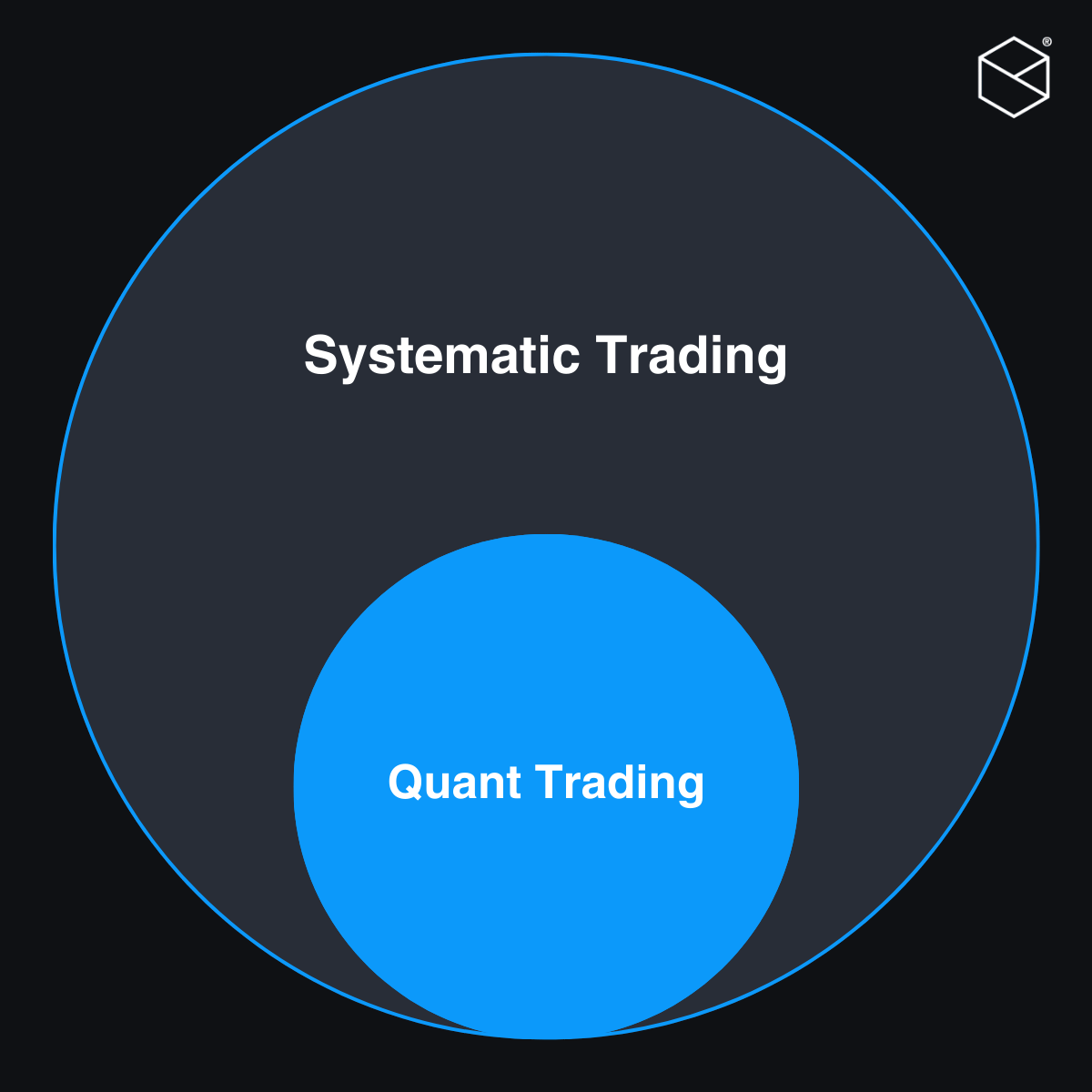
What Quant Trading Means
Quant trading is, at its core, systematic trading powered by data, models, and rules.
It means making decisions using:
Data
Mathematical models
Statistical reasoning
Algorithmic rules
In practice, quant trading usually includes:
• A hypothesis (e.g. trends persist, cheap assets outperform)
• Measurable signals (momentum, valuation, macro, alt data)
• Statistical testing and validation
• Portfolio construction (sizing, constraints, diversification)
• Risk modeling (vol targeting, drawdown control, hedging)
• Often automation (backtesting, execution, monitoring)
Examples of Quant Trading
To make this less abstract, quant trading includes:
• Factor trading (value, momentum, quality, low vol)
• Statistical arbitrage (pairs trading, mean reversion)
• Trend following / CTA-style systems
• Volatility and options strategies
• Market making
• ML-driven strategies (careful: often overhyped)
• Carry / term structure (rates, FX, futures, vol carry)
• Risk premia / style premia (institutional framing of factors)
• Liquidity / microstructure signals
• Event-driven quant (earnings drift, announcement effects, flows)
What Quant Trading Is Not
Quant trading is not necessarily:
• “AI trading”
• High-frequency
• Complex
• Guaranteed to beat the market
These are often misconceptions. The defining characteristic is not hype or speed. It is rigorous, model-driven decision logic.
When Does Systematic Become Quant?
A systematic strategy becomes quant when its rules are derived from statistical research and model-based decision logic, not just fixed heuristics.
You’ve crossed into quant territory when you introduce:
Statistical validation of signals
Cross-sectional ranking or factor modeling
Explicit risk modeling
Portfolio optimization under constraints
Signal combination based on quantitative weighting
Parameter estimation grounded in data rather than convention
In Short
Systematic = rule-based execution.
Quant = research-driven modeling that determines the rules.
The difference is not automation.
It’s the depth of statistical reasoning behind the rules.